



This Victron MultiPlus-II 2×120 wiring diagram guide explains how Victron’s split-phase inverter-charger fits into a 50A RV. The 2×120 accepts a split-phase 120/240V source (50A shore power) or a single 120V source, with up to 50A per leg. It’s one of the most popular upgrades in big-RV builds, and also one of the most misunderstood, because of how it handles L2 and 240V loads.
Electrical work can be dangerous: follow the manual, fuse and size every cable correctly, and use a licensed electrician for anything connected to household wiring.

Victron MultiPlus-II 2×120 Wiring Diagram: The Layout
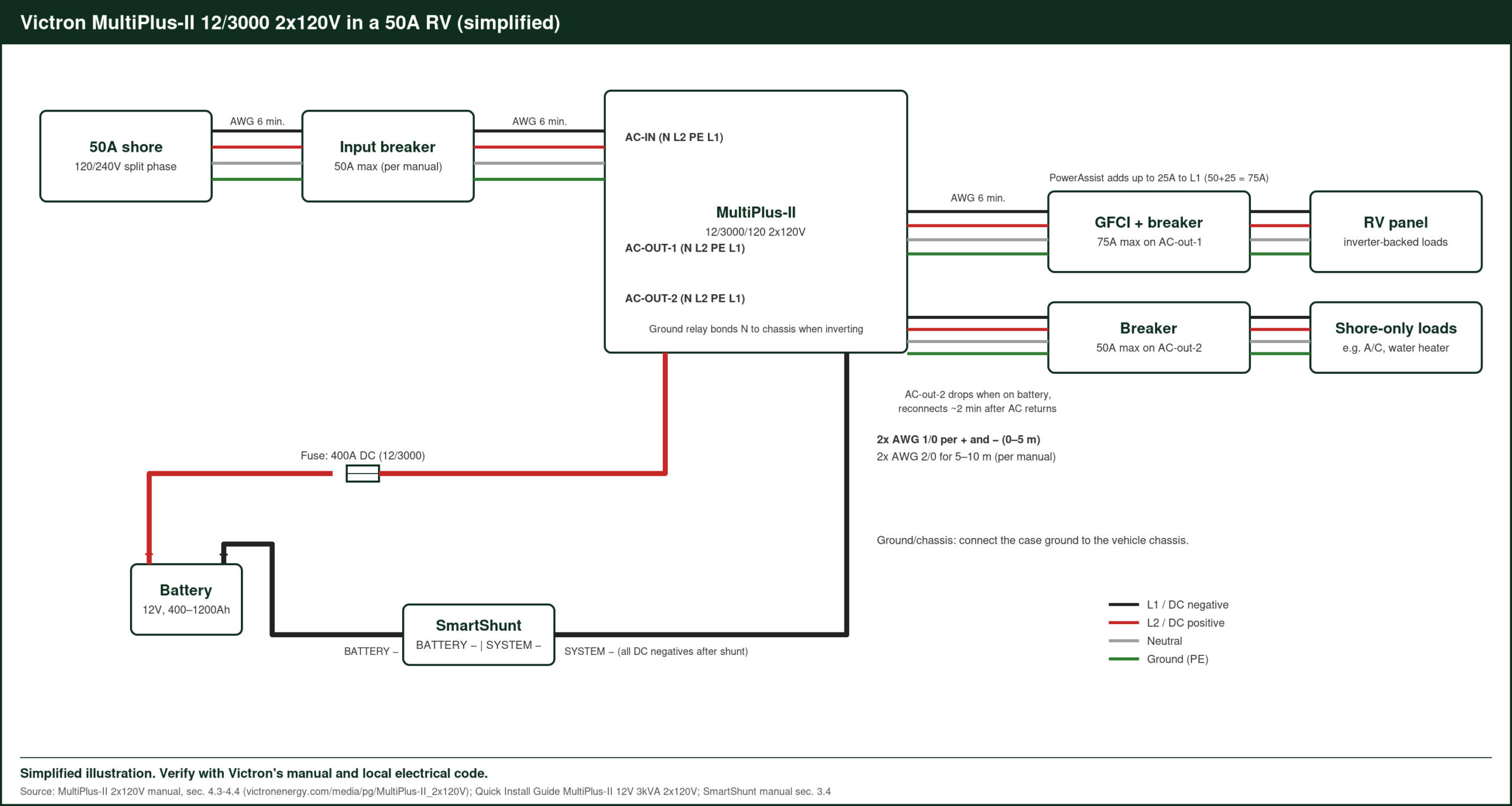
- Shore inlet / generator → transfer switch (if any) → MultiPlus AC IN (L1, L2, N, G).
- MultiPlus AC OUT → RV main breaker panel. Both legs of the panel are fed.
- Battery → main fuse → shunt → busbars → MultiPlus DC terminals.
- Chassis/ground bonding per the manual and code.
- VE.Bus → Cerbo GX for monitoring and settings (optional).
How L1 and L2 Behave
| Situation | L1 output | L2 output | 240V loads |
|---|---|---|---|
| Split-phase shore power | Passed through | Passed through | Work |
| Single 120V input (30A adapter) | Passed through | Fed from the single input (verify in manual) | Don’t work |
| Inverting from battery | Inverter | Tied to L1 | Don’t work |
Source: Victron MultiPlus-II 2x120V datasheet. Charging happens from L1 only. L2 transfer takes about 40ms, longer than L1.
That 40ms L2 gap can reset sensitive electronics; put clocks and computers on L1 where possible.
Battery Side
The 12/3000 model can draw well over 200A from the battery at full output (estimate: 2,400W ÷ 12V ÷ ~0.9 efficiency ≈ 222A). That’s why many RV builders choose the 24V version. Follow Victron’s manual for cable size and fuse rating.
Settings After Wiring
Set the AC input current limit to match your pedestal (e.g. 50A or 30A), configure the battery charge profile for your chemistry, and enable the ground relay settings appropriate to your installation.
As an Amazon Associate I earn from qualifying purchases, at no cost to you.
Buy: Victron MultiPlus-II 2x120V 12/3000 on Amazon
Worked Example: Load Planning on Inverter Power
When running from the battery, L1 and L2 are tied together and fed by the inverter’s 2,400W continuous rating (12/3000 model at 25°C). A sample evening load:
| Load | Watts (example) |
|---|---|
| One 13,500 BTU roof air conditioner (running) | ≈ 1,300W |
| Residential fridge | ≈ 150W |
| TV and router | ≈ 100W |
| Lights and fans | ≈ 100W |
| Total | ≈ 1,650W |
That’s within 2,400W, so it runs on the inverter. Adding a 1,000W microwave at the same time would exceed it. A soft starter on the air conditioner helps with its starting surge. Example wattages; check your appliance labels.
Worked Example: Battery Draw on 12V vs 24V
At 1,650W, the 12V model draws about 153A from the battery (1,650 ÷ 12 ÷ 0.9), while the 24V model draws about 76A (estimates). Halving the current means smaller cables, smaller fuses and less heat, which is why many 50A RV conversions choose 24V.
Worked Example: Plugging Into 30A Shore Power
With a 50A-to-30A adapter, the RV receives a single 120V leg. Set the AC input current limit to 30A. The MultiPlus passes that to L1 and, per the manual’s behaviour for single 120V input, L2 as well, so all 120V circuits work, but 240V loads don’t. PowerAssist adds battery power when loads briefly exceed 30A.
Step-by-Step Installation Order
- Plan circuits: decide which panel circuits are fed by the MultiPlus and whether any heavy 240V loads stay on shore power only.
- Mount the MultiPlus close to the batteries, on a vertical surface with clearance for airflow.
- Install the DC side: battery, main fuse, SmartShunt, busbars, then the MultiPlus DC cables.
- Wire AC IN from the shore inlet (or transfer switch) with L1, L2, neutral and ground.
- Wire AC OUT to the RV’s main panel.
- Have an electrician verify neutral-ground bonding and the ground relay configuration.
- Power up, then configure with VictronConnect or VEConfigure.
Keeping Sensitive Loads on L1
Because L2 transfers more slowly than L1 when shore power drops, plan which breakers sit on which leg. Computers, routers, a residential fridge’s control board and clocks are better on L1. Heavier loads that don’t mind a brief interruption, like a water heater element or a second air conditioner, can go on L2. Moving a breaker from one bus to the other in the RV panel is a small job for an electrician during the install.
Settings Worth Checking
- AC input current limit: 50A on a 50A pedestal, 30A on an adapter, lower on a generator.
- Charge current: suit your battery bank’s maximum charge rate.
- PowerAssist: on, for weak shore supplies.
- Battery profile: lithium or lead-acid, matching your battery’s datasheet.
Adding Monitoring
Connect the VE.Bus port to a Cerbo GX to see both legs’ input and output power, the battery’s state of charge from the SmartShunt, and to change the input current limit from a GX Touch screen in the RV. With internet, VRM shows the same data remotely.
FAQ
Will my RV air conditioners run on the inverter?
120V air conditioners can, within the 2,400W continuous rating. 240V appliances such as some dryers only run on split-phase shore power.
Can I use two 2×120 units?
Yes; Victron supports parallel configurations.
Does it charge from both legs?
No. Victron’s datasheet says it charges from L1 only.
Do I need a separate transfer switch with a generator?
If the RV has both a generator and shore power, the existing automatic transfer switch usually stays in place upstream of the MultiPlus, which then sees whichever source is selected.
Can I run both air conditioners on the inverter?
Two roof units together often exceed 2,400W continuous, so plan to run one at a time on battery, or use two MultiPlus units in parallel for more inverter power.
Sources: Victron MultiPlus-II 2x120V datasheet and product page (victronenergy.com); All About RV’s, “Is This The Best Inverter For RVing. Multiplus 2×120 24 volt.”; chrsbrq, “Multiplus II 2X120 24V install”.
Related: EcoFlow Delta 3 Max RV Air Conditioner, EcoFlow Delta 3 Max RV Boondocking, Klein CL390 Clamp Meter Solar Panel Test, plus the Victron Energy Guide