
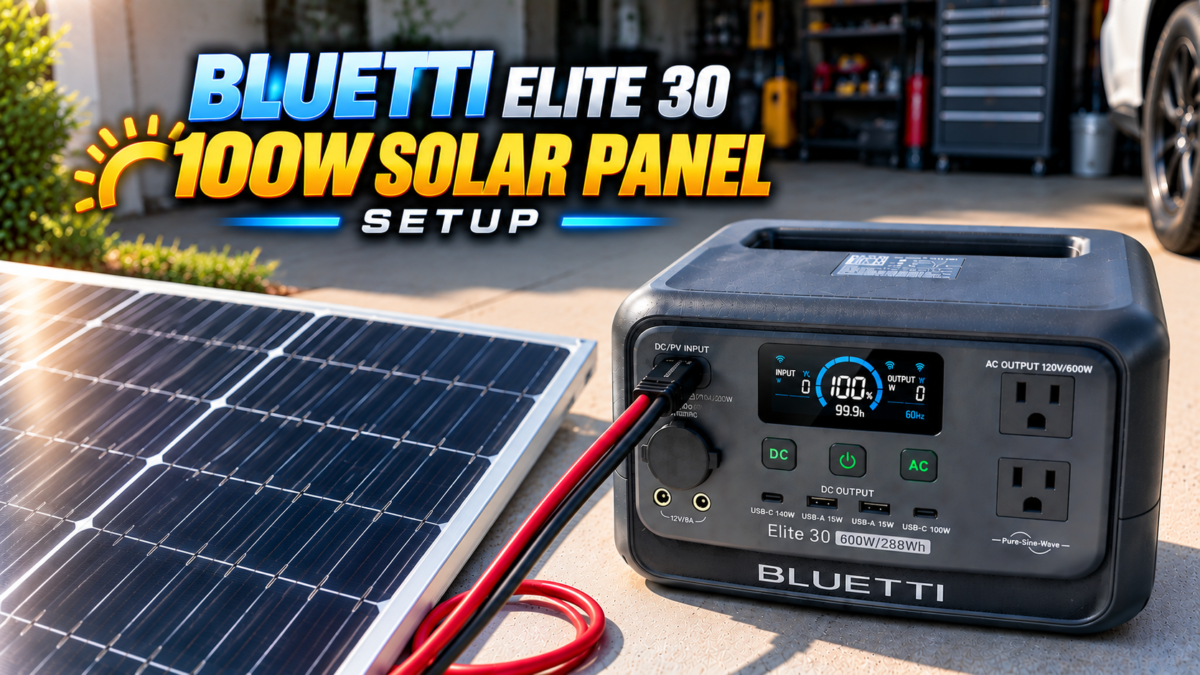
The BLUETTI Elite 30 V2 is a compact 288Wh LiFePO4 portable power station that supports up to 200W of solar input. I wanted to see how it would work with a smaller solar panel that I already own, so I connected it to my HQST 100W solar panel and monitored the solar power coming into the BLUETTI.

I also used the Elite 30 V2 to power a standing lamp and charge my iPad while testing its ability to receive solar power.
If you’re considering the BLUETTI Elite 30 V2 for emergency backup power, outdoor use, or a small solar generator system, this test gives you an idea of what you can expect when pairing it with a 100W solar panel.
Products Used in My Solar Charging Test
👉 MC4 Solar to XT60 Extension Cable
For business inquiries and collaborations: luisangel@aemind.com
If you purchase an item through the links provided, I may receive a commission from the Amazon Influencer Program. Thank you for supporting the channel.
BLUETTI Elite 30 V2 Specifications
The BLUETTI Elite 30 V2 is designed as a relatively small portable power station, but it still provides enough output for a variety of everyday electronics.
Some of its main specifications include:
- 288Wh LiFePO4 battery
- 600W continuous AC output
- Up to 1500W Power Lifting Mode
- Up to 200W solar input
- 12V to 28V DC input range
- 10A maximum DC input
- Pass-through charging
- Approximately 9.4 pounds
- UPS functionality with approximately 10ms switching
- Multiple AC, solar, car, and other charging options
The LiFePO4 battery chemistry is another reason this type of power station is attractive for frequent use. LiFePO4 batteries are commonly used in modern portable power stations because of their long cycle life, thermal stability, and durability.
Testing the BLUETTI Elite 30 V2 With a 100W Solar Panel
For my test, I paired the power station with an HQST 100W 12V monocrystalline solar panel.
The HQST panel has an open-circuit voltage of approximately 20.4V, which is important because the BLUETTI Elite 30 V2 accepts a DC input voltage between 12V and 28V.
I connected the solar panel to the power station using an MC4 solar to XT60 extension cable.
Once everything was connected, I positioned the HQST panel outside where it could receive direct sunlight.
The display on the Elite 30 V2 allowed me to monitor the amount of solar power entering the power station in real time.
How Much Power Can a 100W Solar Panel Actually Produce?
One of the most important things to understand about solar panels is that a 100W solar panel does not necessarily produce 100 watts continuously.
The 100W rating represents the panel’s rated output under specific test conditions.
Real-world solar production can vary based on several factors, including:
- Sun intensity
- Time of day
- Solar panel angle
- Panel orientation
- Temperature
- Clouds
- Shading
- Cable length
- Conversion losses
Because of this, seeing less than the panel’s full 100W rating does not automatically mean something is wrong with the solar panel or power station.
This is one reason I like being able to see the actual incoming solar wattage directly on the BLUETTI Elite 30 V2 display.
HQST 100W Solar Panel Specifications
The HQST 100W solar panel I used is a 100W monocrystalline solar panel designed for 12V solar systems.
Some of its specifications include:
- 100W rated output
- Monocrystalline solar cells
- Up to 23% conversion efficiency
- Approximately 20.4V open-circuit voltage
- Approximately 17.4V operating voltage
- Aluminum frame
- IP65-rated solar connectors and junction box
- Pre-drilled mounting holes
Its voltage specifications make it a much better electrical match for the Elite 30 V2 than some higher-wattage panels.
And that brings up an important point when choosing a solar panel for a portable power station.
Solar Panel Wattage Isn’t the Only Specification That Matters
It can be tempting to simply match the maximum solar wattage of your power station with a solar panel of the same wattage.
For example, the BLUETTI Elite 30 V2 supports up to 200W of solar input, so you might assume that any 200W solar panel will work.
That’s not necessarily the case.
You also need to check the panel’s voltage and current.
The BLUETTI Elite 30 V2 accepts:
- 12V to 28V DC
- Up to 10A
- Up to 200W
BLUETTI specifies that solar panels with an open-circuit voltage above the supported input voltage should not be connected.
Why I Didn’t Use My 200W Solar Panel
I also own a BougeRV Arch Pro 200W flexible solar panel, but I did not connect it to the BLUETTI Elite 30 V2.
The reason is voltage.
My HQST 100W panel has an open-circuit voltage of approximately 20.4V, which falls within the BLUETTI’s 12V to 28V DC input range.
The BougeRV 200W panel has approximately:
- 31V operating voltage
- 36V open-circuit voltage
Even though the BougeRV panel’s 200W rating matches the BLUETTI’s maximum 200W solar input, its voltage is higher than the Elite 30 V2’s specified input range.
Because of that, I did not connect the panel.
This is an important reminder when connecting practically any solar panel to a portable power station:
Always check voltage, amperage, and wattage before making the connection.
Matching the wattage alone is not enough.
Using the BLUETTI While Solar Charging
After testing the solar input outside, I also used the BLUETTI Elite 30 V2 to power some everyday devices.
I plugged my standing lamp into one of the AC outlets and used the power station to keep the lamp running.
This is a simple example, but it’s also one of the ways I could realistically use a smaller portable power station during a power outage.
If the electricity goes out at night, being able to keep a room illuminated without running a generator can be extremely useful.
At the same time, I used the Elite 30 V2 to charge my iPad.
Does the BLUETTI Elite 30 V2 Support Pass-Through Charging?
Yes. The BLUETTI Elite 30 V2 supports pass-through charging, meaning it can receive power while simultaneously providing power to connected devices.
That gives you more flexibility when using solar.
For example, during the day you could have a compatible solar panel feeding power into the BLUETTI while the power station is also being used to charge electronics or run smaller appliances.
That can be particularly useful during an extended power outage or when using the Elite 30 V2 away from the electrical grid.
Using a Small Power Station During a Power Outage
With a 288Wh battery, I wouldn’t look at the Elite 30 V2 as something intended to power an entire home.
I see it more as a way to keep important smaller devices operating.
Depending on power consumption, I could use it for things such as:
- Lamps
- Phones
- Tablets
- Laptops
- Internet equipment
- Small electronics
- USB-powered devices
- Other lower-power appliances
Then, during daylight hours, a compatible solar panel such as the HQST 100W panel can help replenish some of the energy being used.
For my needs, that’s where a compact LiFePO4 power station like this makes the most sense.
BLUETTI Elite 30 V2 and 100W Solar Panel Combination
Pairing the BLUETTI Elite 30 V2 with the HQST 100W solar panel gives me a relatively compact solar power system.
The power station weighs less than 10 pounds, and the 100W panel provides a way to recharge it without needing access to a wall outlet.
The BLUETTI can technically accept up to 200W of solar input, so a compatible higher-output solar configuration could potentially provide faster charging under good conditions.
However, any panel or panel configuration still needs to remain within the Elite 30 V2’s supported voltage and current specifications.
Final Thoughts
After connecting my HQST 100W solar panel to the BLUETTI Elite 30 V2, I was able to monitor the incoming solar power directly from the power station while using the BLUETTI for everyday electronics.
For me, the combination makes the most sense as a compact backup power solution.
I can use the BLUETTI to keep basic devices running during an outage and then use solar power during the day to help recharge the battery.
My biggest takeaway from this test is also something that applies to almost every portable solar power station:
Don’t choose a solar panel based on wattage alone.
Check the power station’s supported voltage, amperage, and wattage range first. A 200W solar panel is not automatically compatible with a power station just because that power station advertises 200W of maximum solar input.
In my case, the electrical specifications of the HQST 100W solar panel made it the appropriate panel to use with the BLUETTI Elite 30 V2.
Frequently Asked Questions
Can you connect a 100W solar panel to the BLUETTI Elite 30 V2?
Yes, provided the solar panel’s voltage and current are within the BLUETTI Elite 30 V2’s supported input specifications. The HQST 100W panel I used has an open-circuit voltage of approximately 20.4V, which falls within the Elite 30 V2’s 12V to 28V DC input range.
What is the maximum solar input for the BLUETTI Elite 30 V2?
The BLUETTI Elite 30 V2 supports up to 200W of solar input, with a specified DC input range of 12V to 28V and a maximum current of 10A.
Will a 100W solar panel produce exactly 100 watts?
Usually not. Solar panel output varies based on sunlight, temperature, panel angle, shading, weather conditions, cable losses, and other factors.
Can you use the BLUETTI Elite 30 V2 while it is charging?
Yes. The Elite 30 V2 supports pass-through charging, allowing it to receive power while also supplying power to connected devices.
Can I connect any 200W solar panel to the BLUETTI Elite 30 V2?
No. A panel’s wattage is only one part of determining compatibility. You also need to make sure its voltage and current remain within the power station’s supported input range.
Is the BLUETTI Elite 30 V2 a LiFePO4 power station?
Yes. The BLUETTI Elite 30 V2 uses a 288Wh LiFePO4, or LFP, battery.
Watch My BLUETTI Elite 30 V2 Solar Charging Test
In my video, I show the BLUETTI Elite 30 V2 connected to the HQST 100W solar panel, monitor its solar input, and demonstrate how I can use the power station for everyday electronics.
If you’re researching the BLUETTI Elite 30 V2, compatible solar panels, or a small LiFePO4 solar generator system, you can watch the full test on my YouTube channel.