



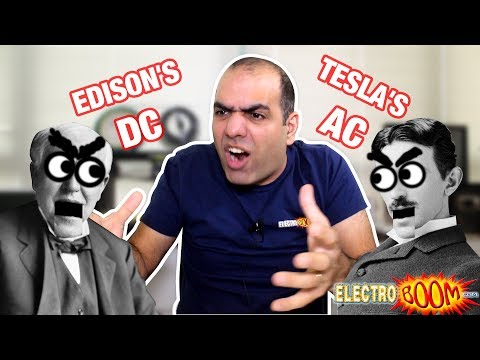
AC instead of DC became the standard for homes because transformers made it cheap to change voltage, and high voltage is what makes long-distance power lines practical, according to the U.S. Department of Energy’s “War of the Currents” history and the demonstration in the ElectroBOOM video embedded below. That history explains why your outlets are AC while your solar panels, batteries and phone run on DC, and why DC is now making a comeback where electronics can do the transformer’s job.
AC Instead of DC: The Core Difference
- DC (direct current): flows one way at a steady voltage. Batteries, solar panels, electronics.
- AC (alternating current): reverses direction 60 times a second in the US (50 in much of the world).
Reason 1: Transformers
A transformer is just two coils of wire on an iron core. It steps AC voltage up or down with no moving parts and high efficiency. Until modern power electronics, there was no cheap way to do that with DC.
Reason 2: Distance
Power loss in a wire is I²R: it grows with the square of the current. Sending the same power at 10 times the voltage needs one-tenth the current and cuts resistive loss to about 1%. Transformers let utilities transmit at hundreds of kilovolts, then step down to 120/240V near your home.
Reason 3: Motors
AC induction motors are simple, rugged and cheap, and they ran the factories and appliances of the 20th century.
Reason 4: History
In the 1880s and 1890s, Edison’s DC systems needed a power plant every mile or so. Westinghouse and Tesla’s AC system could serve whole regions. AC became the standard, and the grid has been built around it ever since.
Where DC Is Winning Now
- Solar and batteries are naturally DC
- High-voltage DC (HVDC) lines move power very long distances and under the sea
- Electronics convert AC to DC inside every charger
- EV fast chargers deliver DC straight to the battery
- Data centers and some homes are testing DC distribution
What This Means for Your Solar System
Every conversion loses a little energy. Solar DC → inverter → AC → charger → DC battery wastes a few percent each step. That’s why DC-coupled batteries and running 12V loads directly from a battery can be more efficient.
| Conversion | Typical efficiency |
|---|---|
| Good inverter | ~90-96% |
| Battery charger | ~85-95% |
| DC-DC converter | ~90-97% |
What the ElectroBOOM Demonstration Shows
In the video above, Mehdi Sadaghdar builds a small “transmission line” out of thin wire and tries to push 10A through a 1-ohm load at 10V. The thin line heats up and smokes, and the voltage at the load sags to around 7V, because so much is lost in the wire’s resistance. He compares this to Edison’s low-voltage DC systems, which he says could only serve customers within about a mile or two of the power plant.
Then he does it the Tesla way: he steps the voltage up with a transformer, sends it down the same thin line, and steps it back down at the far end. The first attempt goes badly because microwave-oven transformers aren’t designed for the job. After adjusting the setup, he gets about 10V across the load, with the line running at hundreds of volts and no longer overheating. His point: higher line voltage means lower line current for the same power, and the wire’s heating loss drops with the square of the current.
The Math Behind It
Power is volts × amps, and a wire’s heating loss is current² × resistance. Illustrative: deliver 10,000W over a line with 1 ohm of resistance.
| Line voltage | Line current | Loss in the line (I²R) | Share of the power lost |
|---|---|---|---|
| 200V | 50A | 2,500W | 25% |
| 2,000V | 5A | 25W | 0.25% |
| 20,000V | 0.5A | 0.25W | 0.0025% |
Each tenfold increase in voltage cuts the loss a hundredfold. ElectroBOOM uses a 20× example: 20 times the voltage means one-twentieth the current and 400 times less power wasted in the wires. That’s why utilities transmit at tens to hundreds of kilovolts and step down near your home.
A Short Timeline of the War of the Currents
| Period | What happened |
|---|---|
| 1882 | Edison’s Pearl Street Station in New York begins supplying DC power |
| Mid-1880s | Practical AC transformers are developed |
| 1888 | Tesla’s AC induction motor patents; Westinghouse licenses them |
| 1893 | Westinghouse lights the Chicago World’s Fair with AC |
| 1890s | Niagara Falls hydroelectric plant sends AC power to Buffalo |
| 20th century | AC becomes the standard for grids worldwide |
The U.S. Department of Energy’s history notes that DC’s big drawback was that it couldn’t easily be converted to higher or lower voltages.
Why Not Convert to DC at the Pole?
Viewers under the video asked a good question: if most devices convert AC to DC anyway, why not do it once at the transformer outside the house? A few practical reasons:
- Every appliance and outlet in the country is built for AC, and motors, heaters and many appliances use it directly.
- Different devices need different DC voltages: 5V for USB, 12V or 19V for laptops, about 400V for an EV battery. They still need their own converters.
- AC is easier to switch off. AC voltage passes through zero 120 times a second at 60 Hz, which helps an arc go out when a breaker or switch opens. DC doesn’t cross zero, so DC breakers and switches need special ratings to interrupt it.
- Low-voltage DC would need thick wire. A 12V DC house would need 10 times the current of a 120V house for the same power.
Do AC and DC Need Different Wire Sizes?
Another viewer asked whether DC needs a different wire diameter. At the same voltage and current, household AC and DC heat a wire about the same, so ampacity tables apply to both at these sizes. The difference comes from voltage: low-voltage DC systems carry far more current for the same power, so they need much thicker cable. See the wire gauge chart.
Why Don’t Transmission Lines Melt?
High voltage means low current. The heat in a wire depends on current, not voltage, so a line at hundreds of kilovolts carrying a modest current runs cool enough. The high voltage is handled by air spacing and insulators, which is why transmission lines hang high and far apart. As ElectroBOOM puts it, “with high voltage comes great responsibility.”
HVDC: DC’s Long-Distance Comeback
Modern power electronics can convert DC voltage efficiently, so high-voltage DC (HVDC) is now used where it beats AC: very long overland lines, undersea cables, and links between grids that aren’t synchronized. The Pacific DC Intertie, for example, carries power more than 800 miles from the Pacific Northwest to Southern California.
AC vs DC Ceiling Fans
One viewer asked which ceiling fan type saves more. “DC” ceiling fans still plug into AC wiring. They use an electronic driver and a brushless DC motor, which is generally more efficient than a traditional AC induction motor. To compare models, look at airflow efficiency (CFM per watt) on the box or the ENERGY STAR listing.
What Runs on DC in Your Home Today
| Device | Power it gets | What happens inside |
|---|---|---|
| Phone and laptop chargers | 120V AC | Converted to 5–20V DC |
| LED bulbs | 120V AC | A small driver makes DC for the LEDs |
| TV and computer | 120V AC | Internal power supply makes DC |
| Inverter mini-split | 240V AC | Rectified to DC, then inverted to drive the compressor at variable speed |
| Solar panels and batteries | Their own DC | Inverter makes AC for the house |
| EV | AC (Level 1/ | Battery always stores DC |
Most of the electronics in a modern home are DC inside, which is why researchers are studying DC distribution. For now, AC wiring with converters at each device remains the standard.
FAQ
Why don’t homes use DC?
The grid, outlets and appliances are built for AC, and AC voltage is easy to change with transformers.
Is AC or DC more dangerous?
Both are dangerous at household voltages. See our amps vs volts guide.
Will homes switch to DC?
Parts may, through DC-coupled solar and batteries, but AC outlets will be around for decades.
What is the main reason homes use AC?
Transformers change AC voltage easily, which makes efficient long-distance transmission possible.
Why do electronics use DC if homes are AC?
Chips need steady, low DC voltage, so every charger and power supply converts AC to DC inside.
Is DC more efficient than AC?
Neither is always more efficient. AC is easier to transform, and HVDC wins over very long distances.
Sources: U.S. Department of Energy, “How Does Electricity Work?” and “The War of the Currents: AC vs. DC Power”; ElectroBOOM, “Why Use AC Instead of DC at Home??” (YouTube). Accessed Oct 2026.
Related: Allwei 1500W Pure Sine Wave Inverter Review, Pro Chaser 400W Car Power Inverter Review