



The Ohm’s law formula is V = I × R: voltage equals current times resistance, the relationship physicist Georg Ohm published in 1827. It’s the most useful equation in DIY electrical work. It explains why cables get hot, why voltage sags under load, and why a dead short on a battery is so dangerous. Here’s the formula, the memory triangle, and worked examples from real solar setups.
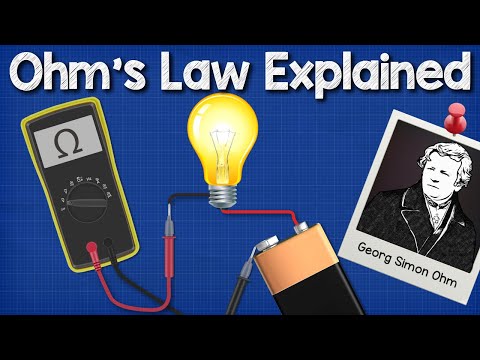
The Ohm’s Law Formula and Triangle
- V = I × R (volts = amps × ohms)
- I = V ÷ R (amps = volts ÷ ohms)
- R = V ÷ I (ohms = volts ÷ amps)
The triangle trick: write V on top and I and R side by side underneath. Cover the one you want, and the other two show you the math. Cover V and you see I next to R (multiply). Cover I and you see V over R (divide).
Add the Power Formulas
Combine Ohm’s law with P = V × I and you get:
| To find | Formula |
|---|---|
| Power from current and resistance | P = I² × R |
| Power from voltage and resistance | P = V² ÷ R |
| Current from power and voltage | I = P ÷ V |
P = I² × R is the key one for wiring. Heat in a cable rises with the square of the current, so doubling the current means four times the heat.
Example 1: Voltage Drop in a 12V Cable
Example math: a 10ft run of 10 AWG copper has 20ft of conductor round trip. NEC Chapter 9, Table 8 lists stranded 10 AWG copper at about 1.24Ω per 1,000ft, so 20ft is about 0.025Ω. At 30A, V = 30 × 0.025 ≈ 0.74V. On a 12V system that’s about 6% lost. A thicker cable or a shorter run fixes it.
Example 2: Why a Short Circuit Is So Dangerous
A LiFePO4 battery has very low internal resistance, often just milliohms. Illustrative math: if total resistance in a short is 0.01Ω, I = 12.8 ÷ 0.01 = 1,280A. That’s enough to melt a wrench and set cable insulation on fire. It’s why every positive cable needs a fuse close to the battery.
Example 3: Heater Element
A 120V, 1,500W heater: I = 1,500 ÷ 120 = 12.5A, and R = 120 ÷ 12.5 = 9.6Ω.
Where Ohm’s Law Doesn’t Fit Neatly
Ohm’s law describes resistive parts. LEDs, motors, inverters and battery chargers don’t behave like fixed resistors. For those, use the wattage or current on the label rather than calculating it from resistance.
Worked Example: Checking a Battery-to-Inverter Cable
Ohm’s law plus a wire resistance table lets you check a cable before you buy it. Illustrative inputs: a 12V system, a 1,000W inverter, and a 6ft cable run (12ft of conductor round trip).
| Step | Math | Result |
|---|---|---|
| DC current (assume 90% efficiency) | 1,000 ÷ 0.9 ÷ 12 | about 93A |
| Resistance, 4 AWG copper (NEC Ch. 9 Table 8, about 0.308Ω per 1,000ft) | 12 × 0.000308 | about 0.0037Ω |
| Voltage drop | 93 × 0.0037 | about 0.34V (2.9%) |
| Heat in cable | 93² × 0.0037 | about 32W |
| Same run in 2 AWG (about 0.194Ω per 1,000ft) | 93 × 12 × 0.000194 | about 0.22V (1.8%) |
The thicker cable halves the wasted heat. Many solar designers target 3% drop or less on battery and DC runs. Run your own numbers with the voltage drop calculation guide and the wire gauge chart for 12V, 24V and 48V.
Ohm’s Law Reference Table
| Known | Find volts | Find amps | Find ohms | Find watts |
|---|---|---|---|---|
| I and R | V = I × R | P = I² × R | ||
| V and R | I = V ÷ R | P = V² ÷ R | ||
| V and I | R = V ÷ I | P = V × I | ||
| P and V | I = P ÷ V | R = V² ÷ P | ||
| P and I | V = P ÷ I | R = P ÷ I² |
Series and Parallel Resistance
- Series: resistances add. R total = R1 + R2 + R3. The same current flows through each.
- Parallel: reciprocals add. 1/R total = 1/R1 + 1/R2. The voltage across each is the same.
Example math: two 10Ω resistors are 20Ω in series and 5Ω in parallel. The same rules explain battery bank wiring, covered in series vs parallel wiring.
Why Loose Connections Get Hot
A loose or corroded lug adds resistance right at one point. Illustrative math: an extra 0.005Ω at 100A dissipates 100² × 0.005 = 50W in a spot the size of a coin. That’s why torque specs matter and why how to crimp battery cable is worth reading before you build.
Measuring It With a Multimeter
- Turn the circuit off before measuring resistance. Ohmmeters inject their own small current.
- Measure voltage across a component while it runs.
- Measure current in series, or with a clamp meter for high DC current.
- Compare V ÷ I to the expected resistance.
Step-by-step instructions are in how to use a multimeter.
Temperature Changes Resistance
Copper’s resistance rises about 0.39% per °C (its temperature coefficient). NEC Table 8 values are given at 75°C, so a cold cable will read slightly lower and a hot one slightly higher. For DIY sizing, the table values are a safe baseline.
FAQ
What is the Ohm’s law formula?
V = I × R, with voltage in volts, current in amps and resistance in ohms.
Can I measure resistance with a multimeter?
Yes, but only with the circuit powered off. Measuring ohms on a live circuit can damage the meter.
Why do thin wires get hot?
Higher resistance means more power is turned into heat (P = I² × R) at the same current.
Does Ohm’s law work for AC?
For purely resistive loads like heaters, yes. With motors and electronics, AC uses impedance instead of plain resistance, so label watts and amps are more reliable.
What is the relationship between Ohm’s law and watts?
Combine V = I × R with P = V × I to get P = I² × R and P = V² ÷ R. See volts, amps and watts explained.
Sources: U.S. Department of Energy, “How Does Electricity Work?” (energy.gov); NFPA 70 (NEC) 2023, Chapter 9 Table 8 conductor properties; NFPA 70 (NEC) Chapter 9 Table 8. Accessed Oct 2026.
Related: Proster Smart Multimeter Review, Klein CL390 Clamp Meter Solar Panel Test, LiTime 12V 50Ah LiFePO4 Battery Review