



This guide explains how to connect Victron batteries in series and parallel to build a 12V, 24V or 48V bank, using Victron’s Lithium Battery Smart datasheet and Lynx manual. Series raises voltage. Parallel raises capacity (amp-hours). Victron’s Lithium Smart batteries support both, and combinations of both, up to 20 batteries in one system.
Electrical work can be dangerous: follow the manual, fuse and size every cable correctly, and use a licensed electrician for anything connected to household wiring.
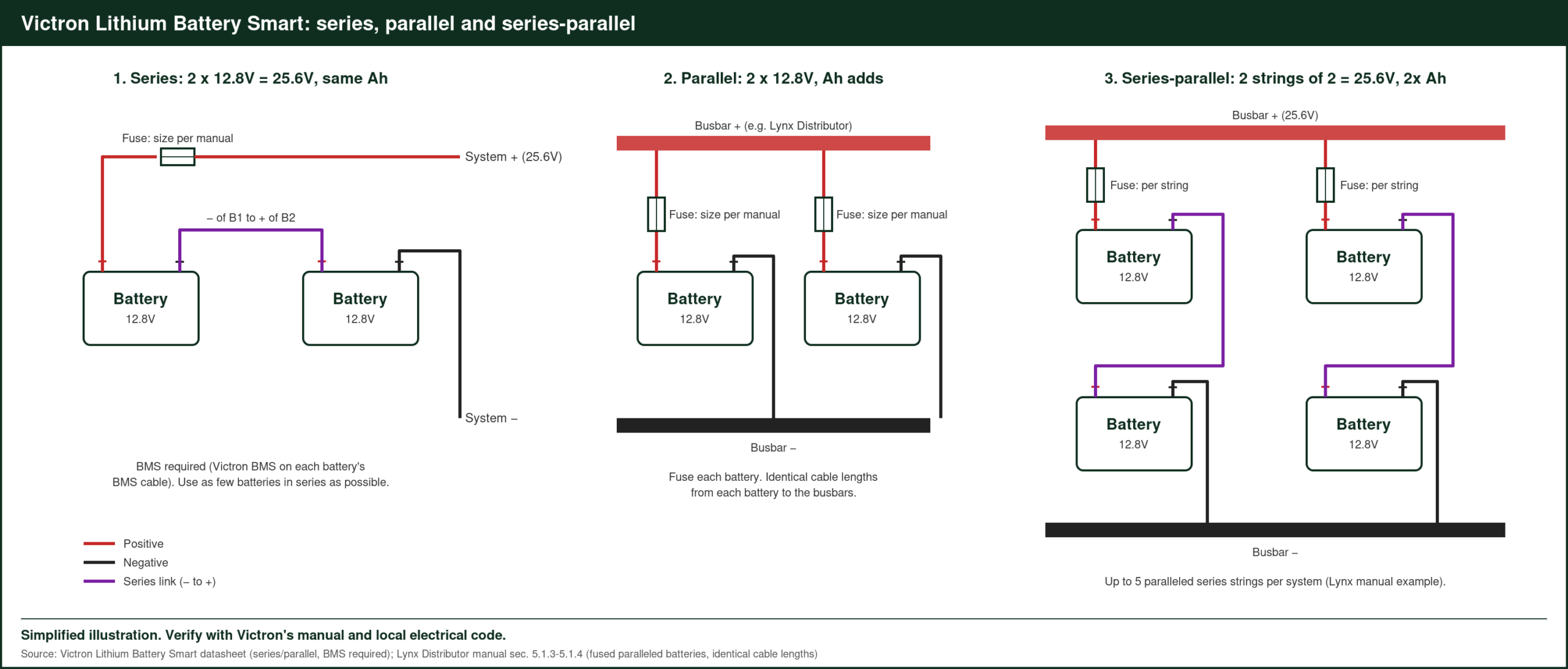
Series vs Parallel: Victron Batteries in Series and Parallel Explained
| Wiring | What happens | Example with 12.8V 200Ah batteries |
|---|---|---|
| Series (+ to −) | Voltage adds, Ah stays the same | 2 in series = 25.6V, 200Ah (5,120Wh) |
| Parallel (+ to +, − to −) | Ah adds, voltage stays the same | 2 in parallel = 12.8V, 400Ah (5,120Wh) |
| Series-parallel | Both | 2 strings of 2 = 25.6V, 400Ah (10,240Wh) |
Total energy (Wh) is the same either way for the same batteries. The system voltage you need depends on your inverter and charger.
Victron’s Rules for Lithium Smart Banks
- Maximum 20 batteries per system. Victron says that allows up to 84kWh at 12V and up to 102kWh at 24V or 48V.
- Use 24V batteries for 24V and 48V. Victron recommends building 24V from 25.6V batteries, and 48V from two 25.6V batteries in series. Four 12V batteries in series work but need more balancing time.
- Use as few batteries in series as possible to reduce balancing time.
- Every battery connects to the BMS. The cell-monitoring cables daisy-chain from battery to battery and end at a Victron BMS. The BMS stops charging or loads if any cell goes out of range.
- Up to 5 parallel series strings per system, per Victron’s Lynx Smart BMS example.
Wiring Parallel Batteries Properly
- Use identical cable lengths from each battery to the busbar. Victron’s diagrams show this every time, so each battery shares the current evenly.
- Fuse each battery or each string. Victron’s Lynx examples show each paralleled battery fused.
- Connect to a busbar, such as a Lynx Distributor, not by daisy-chaining the batteries terminal to terminal.
- Start with matched batteries: same model, capacity, age and state of charge.
Lead-Acid Banks
The same series and parallel rules apply. Victron’s Lynx manual shows four 12V lead-acid batteries in parallel on a Lynx Power In, with identical cable lengths.
Which System Voltage?
Higher voltage means lower current for the same power. A 3,000W inverter pulls about 250A at 12V, 125A at 24V and about 63A at 48V (power ÷ voltage, ignoring losses). That means thinner cable, smaller fuses and less heat. Vans often stay at 12V, while larger RVs, boats and cabins usually move to 24V or 48V.
Want the source figures? The Lithium Battery Smart range page on Victron’s site has the datasheet.
Example Bank Layouts
| Goal | Victron batteries (example) | Wiring | Result |
|---|---|---|---|
| 12V van, about 2.5kWh | 1 × 12.8V 200Ah | Single battery | 12.8V, 200Ah (2,560Wh) |
| 12V RV, about 5kWh | 2 × 12.8V 200Ah | Parallel | 12.8V, 400Ah (5,120Wh) |
| 24V boat, about 5kWh | 2 × 25.6V 100Ah | Parallel | 25.6V, 200Ah (5,120Wh) |
| 48V cabin, about 10kWh | 2 × 25.6V 200Ah | Series | 51.2V, 200Ah (10,240Wh) |
| 48V cabin, about 20kWh | 4 × 25.6V 200Ah | 2 strings of 2 in series | 51.2V, 400Ah (20,480Wh) |
Nominal values from Victron’s datasheet; usable energy depends on how deep you discharge.
Picking a BMS
| BMS | Typical use |
|---|---|
| smallBMS | Small 12V systems, controls charge and load disconnects |
| VE.Bus BMS V2 | Systems with a MultiPlus or Quattro |
| Lynx Smart BMS | Larger systems, with a built-in contactor and Lynx busbar |
Each daisy-chains to every battery’s BMS cables, so it sees every cell in the bank.
Charging a Series Bank
Victron’s Lithium Smart batteries balance cells inside each battery. In a series string, keep the batteries matched and give them time at full charge occasionally so balancing can finish. That’s one reason Victron suggests 25.6V batteries for 48V banks: two batteries in series balance faster than four.
Checking Your Work Before Power-Up
- Measure each battery’s voltage before connecting; they should match closely.
- Check every series link goes positive to negative, and every parallel link positive to positive.
- Confirm cable lengths to the busbar are identical.
- Check that every battery’s BMS cable is connected and the chain ends at the BMS.
- Measure the total bank voltage at the busbar before connecting any loads.
Expanding a Bank Later
Add batteries of the same model and capacity, at the same state of charge, and stay within Victron’s limits of 20 batteries and five parallel strings. Adding a whole parallel string usually works better than adding a single battery to an existing series string.
Monitoring the Bank
A SmartShunt or BMV on the main negative shows the whole bank’s state of charge, current and remaining time. The Lithium Smart batteries also report each battery’s cell voltages over Bluetooth in VictronConnect, so you can check balance from your phone.
Cable Sizing Between Batteries
Series links carry the full bank current, so they need the same cable size as the main battery cables. In a parallel bank, each battery’s cable carries only its share, but sizing every cable for the full current adds a safety margin if one battery disconnects. Keep all links short and torque the terminals to the values in Victron’s manual.
FAQ
Can I mix a new battery with old ones?
Avoid it. Mismatched batteries share current unevenly and are harder to balance.
Do Victron Smart batteries need a BMS in series and parallel?
Yes, always. They have no internal disconnect.
How many batteries can I put in series?
Enough to reach your system voltage. Victron recommends using as few as possible, such as two 25.6V batteries for 48V.
Do I need a separate fuse for each battery?
Victron’s Lynx examples fuse each paralleled battery or string, which protects the others if one has a fault.
Sources: Victron 12.8 & 25.6 Volt Lithium-Iron-Phosphate Batteries Smart datasheet, Victron BMS overview, Lynx Distributor M8 and M10 manual (victronenergy.com).
Related: LiTime 12V 50Ah LiFePO4 Battery Review, XZNY 12V 18Ah LiFePO4 Battery Review, Allwei 1500W Pure Sine Wave Inverter Review, plus the Victron Energy Guide