



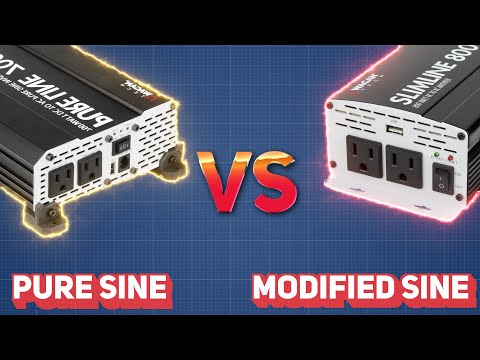
Pure sine wave vs modified sine wave is the first choice you make when buying an inverter. Both turn battery DC into AC, but the shape of that AC decides whether your fridge hums, your laptop charger gets hot, or your CPAP refuses to run. Here’s what actually differs and how to choose.
Electrical work can be dangerous: follow the manual, fuse and size every cable correctly, and use a licensed electrician for anything connected to household wiring.
Pure Sine Wave vs Modified Sine Wave: The Waveform
Utility power in US homes is a smooth sine wave at 60 Hz. A pure sine inverter recreates that smooth curve electronically. A modified sine inverter switches the output in steps, a blocky approximation that has the right average voltage but lots of harmonics.
Appliances were designed for the grid’s smooth wave. Those harmonics are what cause the trouble.
What Works Fine on Modified Sine
- Simple resistive loads: incandescent bulbs, kettles, toasters, basic heaters
- Many universal-motor power tools (drills, angle grinders), often running a little hotter
- Many phone and laptop chargers, though some run warm or buzz
Loads That Run Best on Pure Sine
- Induction motors and compressors (fridges, freezers, pumps, fans): extra heat, humming, lower efficiency
- Medical devices such as CPAP machines: many manufacturers specify pure sine
- Variable-speed tools and dimmers: erratic behavior
- Audio gear: audible buzz
- Some battery chargers and timers: clocks running fast, chargers that won’t start
- Microwaves: often run, but slower and noisier
| Pure sine | Modified sine | |
|---|---|---|
| Waveform | Smooth, grid-like | Stepped |
| Compatibility | Practically everything | Simple loads |
| Motor heating | Normal | Higher |
| Electrical noise | Low | Buzz in audio and some chargers |
| Price | Higher | Lower |
General guidance. Check each appliance maker’s power requirements.
When Modified Sine Still Makes Sense
A small car inverter that only runs a work light, a soldering iron or a phone charger can be modified sine and save money. For a van, RV, cabin or home backup, where you’ll eventually run a fridge or something sensitive, buy pure sine. The price gap has shrunk a lot.
Check These Specs Too
- Continuous and surge watts (see the inverter sizing guide)
- Total harmonic distortion (THD): good pure sine units list under 3–5%
- Idle draw: watts used with nothing plugged in
Waveform Comparison
| Pure sine wave | Modified sine wave | |
|---|---|---|
| Output shape | Smooth curve like grid power | Stepped square-ish wave |
| Total harmonic distortion (THD) | Typically under 3–5% on datasheets | Much higher |
| Motors and compressors | Run cool and quiet | Can run warmer and noisier |
| Electronics and chargers | Full compatibility | Most work, some don’t |
| Cost | Higher | Lower |
THD figures are typical datasheet ranges; check the specific model.
Worked Example: Choosing for a Van
Illustrative loads: a 12V compressor fridge (runs on DC, no inverter needed), a laptop charger (65W), a phone charger, and a small blender (300W).
- The fridge runs on 12V DC directly, so it doesn’t influence the inverter choice.
- Laptop and phone chargers usually work on either type, though they may run warmer on modified sine.
- The blender’s motor will run on either, but more smoothly on pure sine.
- Total running load: about 400W. A 600–1,000W pure sine inverter covers it with headroom.
For a mixed load like this, the price gap at small sizes is modest, so pure sine is the simpler choice. Size it with what size inverter do I need.
Load Compatibility Guide
| Load type | Pure sine | Modified sine |
|---|---|---|
| Resistive heaters, kettles, incandescent bulbs | Yes | Yes |
| Phone and laptop chargers | Yes | Usually |
| Refrigerators and compressors | Yes | Runs best on pure sine |
| Variable-speed tools, dimmers | Yes | Often not |
| CPAP and medical devices | Yes | Check the maker’s guidance |
| Audio equipment | Yes | May produce audible buzz |
| Microwaves | Yes | Run, but often heat more slowly |
Specs to Compare Beyond Waveform
- Continuous and surge watts. See surge watts vs running watts.
- Efficiency and idle draw. See inverter efficiency and idle draw.
- Low-voltage cutoff setting, matched to your battery chemistry.
- Listings such as UL 458 for mobile inverters or UL 1741 for grid-interactive ones.
Home Battery Systems
Home battery and hybrid inverters, like the ones in our home solar battery guide, produce pure sine output because they connect to the home’s wiring and often to the grid.
FAQ
Can a modified sine inverter damage a fridge?
It can shorten its life. The compressor runs hotter and less efficiently, so many fridge makers recommend pure sine.
Will a CPAP run on modified sine?
Some do, but many CPAP makers specify pure sine. Check your manual, and use pure sine to be safe.
Is pure sine worth the extra cost?
For anything with a motor, a compressor or sensitive electronics, yes.
Does pure sine use less battery?
Waveform alone doesn’t decide efficiency. Compare datasheet efficiency and idle draw.
Can I tell which type I have?
The label or manual will say. A modified sine model is usually labeled “modified sine wave.”
Sources: U.S. Department of Energy, “How Does Electricity Work?” and “Estimating Appliance and Home Electronic Energy Use”; appliance manufacturers’ power requirements; UL 458 and UL 1741 standard scopes. Accessed Oct 2026.
Related: Allwei 1500W Pure Sine Wave Inverter Review, Pro-Chaser 400W Car Power Inverter Review