



What size inverter do I need? Bigger isn’t automatically better. An oversized inverter wastes battery through higher idle draw and needs thicker cable. An undersized one trips when the fridge compressor kicks on. Here’s a five-step method and three worked examples.
Electrical work can be dangerous: follow the manual, fuse and size every cable correctly, and use a licensed electrician for anything connected to household wiring.
What Size Inverter Do I Need? Five Steps
- List the loads that could run at the same time, with their running watts from the label or a plug-in meter.
- Add them up. That’s your continuous need.
- Find the biggest startup surge (motors, compressors, pumps) and add it to the other loads’ running watts. That’s your surge need.
- Add margin: about 20–25% over continuous is a common rule of thumb, so the inverter isn’t running at its limit.
- Match the battery voltage, and check the DC current the inverter will pull.
Example 1: Van (Illustrative)
Fridge 60W running (about 400W surge), laptop 65W, fan 30W, phone charging 20W.
- Continuous: 175W, surge: 400 + 115 = 515W, with margin about 220W continuous.
- A quality 500–1,000W pure sine inverter is plenty. A 3,000W unit would mostly waste idle power.
Example 2: RV With a Microwave (Illustrative)
Microwave 1,500W input, fridge 150W (about 900W surge), lights and TV 150W.
- Continuous: 1,800W, surge: about 900 + 1,650 = 2,550W.
- About 2,000–3,000W continuous with good surge. At 12V that’s up to about 250A DC, so 24V is worth considering.
Example 3: Home Backup Circuits (Illustrative)
Fridge, furnace blower 500W (estimate), Wi-Fi, lights, plus occasional well pump 1,000W (about 4,000W start, estimate).
- Continuous with the pump: about 2,000W, surge: about 5,000W or more.
- A split-phase-capable inverter or home battery with high surge, installed by an electrician with a transfer switch or interlock.
Check the DC Side
Example math: inverter DC amps ≈ AC watts ÷ battery volts ÷ efficiency. A 3,000W load at 12V and 90% efficiency is about 278A. At 48V it’s about 69A. That’s why bigger systems move to 48V.
| Inverter size | Common battery voltage |
|---|---|
| Up to ~1,500W | 12V |
| ~1,500–3,000W | 12V or 24V |
| 3,000W and up | 24V or 48V |
Rule of thumb, not a standard. Follow the inverter maker’s voltage options.
Don’t Forget
- Pure sine for motors, medical devices and modern electronics.
- Idle draw: check the no-load watts on the datasheet.
- VA vs W: inductive loads need VA headroom.
Sizing Worksheet
Use this table with your own loads. The rows are illustrative.
| Load | Running W | Startup W | Runs at the same time? |
|---|---|---|---|
| Refrigerator | 150 | 900 (estimate) | Yes |
| Microwave | 1,200 | 1,200 | Sometimes |
| TV and streaming box | 120 | 120 | Yes |
| Lights | 60 | 60 | Yes |
| Coffee maker | 900 | 900 | Rarely with microwave |
- Add the running watts of everything that runs together: 150 + 1,200 + 120 + 60 = 1,530W.
- Add about 25% headroom: 1,530 × 1.25 ≈ 1,910W, so a 2,000W continuous inverter fits.
- Check surge: the largest startup (fridge, 900W) on top of the others (1,380W) ≈ 2,280W, so look for a peak rating well above that.
- Decide on the coffee maker: running it with the microwave would push past 2,400W, so either stagger them or size up.
Startup numbers are covered in surge watts vs running watts, and appliance numbers in how many watts does a microwave use.
Inverter Size vs Battery Voltage
| Inverter continuous | DC current at 12V | at 24V | at 48V |
|---|---|---|---|
| 1,000W | 93A | 46A | 23A |
| 2,000W | 185A | 93A | 46A |
| 3,000W | 278A | 139A | 69A |
| 5,000W | 463A | 231A | 116A |
Calculated as W ÷ 0.9 assumed efficiency ÷ V. Above about 2,000–3,000W, the current at 12V gets hard to cable and fuse, which is why larger inverters are usually sold in 24V or 48V versions. See 12V vs 24V vs 48V.
Idle Draw Adds Up
An inverter uses some power just by being on, listed as “no-load” or “idle” consumption on the datasheet. Illustrative math: a 30W idle draw for 24 hours costs 720Wh a day, more than half of a 12V 100Ah LiFePO4 battery. Many inverters offer a power-save or search mode to reduce it. See inverter efficiency and idle draw.
Waveform and Features
- Pure sine output for electronics, motors and medical devices.
- Built-in charger (an inverter-charger) if you’ll recharge from shore power or a generator.
- Transfer switch if it should take over automatically during an outage.
- Split-phase 120/240V output if you need to run 240V loads like a well pump.
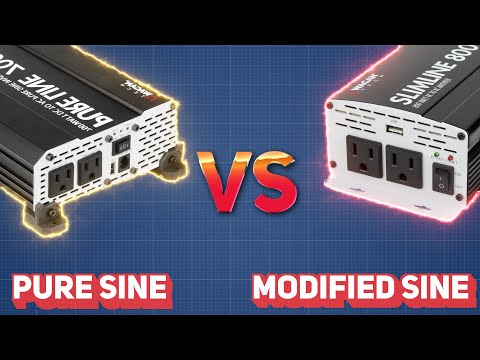
Waveform differences are explained in pure sine wave vs modified sine wave.
FAQ
What size inverter do I need for a fridge?
Usually 1,000W or more, to handle the compressor’s startup surge, even though it runs at only 100–250W.
Can I run a 2,000W inverter on one 100Ah battery?
Briefly. 2,000W from 12.8V is about 170A, which may exceed the battery’s BMS limit. Check the battery’s continuous discharge rating.
Is a bigger inverter safer?
Not by itself. Cable and fuse sizes have to match the inverter’s maximum current.
Should I size for continuous or peak watts?
Size continuous for everything that runs together, then confirm the peak rating covers your biggest startup.
What size inverter do I need for a 1,000W microwave?
A microwave labeled 1,000W cooking power often draws around 1,500W input, so check the label’s input rating and pick an inverter with headroom above that.
Sources: U.S. Department of Energy, “Estimating Appliance and Home Electronic Energy Use”; NFPA 70 (NEC) 2023 Articles 240, 702 and 710. Accessed Oct 2026.
Related: Pro-Chaser 400W Car Power Inverter Review, Allwei 1500W Pure Sine Wave Inverter Review, EcoFlow Delta 3 Max Efficiency and Idle Draw