



This review of the Victron Lynx Power In and Lynx Class-T Power In covers the two modules that bring battery power into a Lynx DC distribution system. They look almost the same, but they do different jobs. The Lynx Power In is a plain busbar. The Lynx Class-T Power In adds Class-T fuses for lithium battery strings. Here’s what each does, using Victron’s product pages and the Lynx Distributor manual.
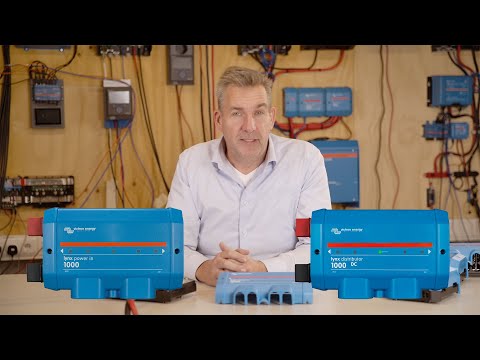
Lynx Power In vs Lynx Class-T Power In: At a Glance
| Lynx Power In | Lynx Class-T Power In | |
|---|---|---|
| Job | Busbar to connect batteries or DC devices | Connects and fuses up to 2 lithium battery strings |
| Fuses | None | 2 Class-T fuses (225A, 250A, 350A or 400A, sold separately) |
| Busbars | Positive and negative, M10 | Positive and negative, M10 |
| Ground connection | — | Yes, to ground the DC system |
| Module current rating | 1000A (Lynx system) | 1000A (Lynx system) |
Sources: Lynx Power In and Lynx Class-T Power In product pages; Lynx Distributor manual.
Lynx Power In
Victron describes the Lynx Power In as the module “to connect batteries to the Lynx DC distribution system.” It has four connections. It has no fuses, so each battery string needs fusing somewhere else. That might be a Lynx Shunt VE.Can, which holds a main fuse, or fuses at the batteries.
Lynx Class-T Power In
The Class-T version has positive and negative busbars, two Class-T fuse holders and a DC ground connection. Class-T fuses have a high interrupt rating, which is why they’re commonly used on large lithium banks, where short-circuit currents can be very high. For three or more battery strings, Victron says to use more than one Class-T module.
Where They Fit in a Lynx Chain
- Batteries → Lynx Power In or Class-T Power In
- → Lynx Shunt VE.Can or Lynx Smart BMS (monitoring, main switch)
- → Lynx Distributor (MEGA-fused outputs to the inverter, MPPTs and loads)
The Lynx Distributor manual says each Lynx module is rated 1000A, or 12kW at 12V. The total of all the fuses shouldn’t exceed the lowest-rated module in the chain.
Who It’s For
- Lynx Power In: systems that already fuse each battery, or lead-acid banks that use a Lynx Shunt main fuse.
- Class-T Power In: one or two lithium strings where you want Class-T protection built into the busbar.
- Skip both: small van systems with one battery and a simple fuse block.
What We’d Like to See
Victron sells the fuses separately, so add them to your budget. Order the M10 versions so they match the current Lynx range.
Want the source figures? The Lynx Class-T Power In page on Victron’s site has the datasheet.
Scenario 1: Upgrading a Lead-Acid Bank to Lithium
An owner has a Lynx Power In with four AGM batteries wired in parallel and a Lynx Shunt holding the main fuse. Switching to two lithium batteries, they can either keep the Lynx Power In and add separate Class-T fuse holders at each battery, or swap the Lynx Power In for a Lynx Class-T Power In. The swap puts both Class-T fuses into the busbar and removes two external fuse holders and their extra cable runs.
Scenario 2: Several Small Batteries
A van with four 100Ah batteries already fused at each battery terminal doesn’t need Class-T fusing in the busbar. A Lynx Power In with four connections collects all four batteries in one tidy spot. Its job is purely to connect, so it’s the simpler and lower-cost choice here.
Scenario 3: A Four-String Lithium Bank
A boat with four lithium strings that wants Class-T protection on each one needs two Lynx Class-T Power In modules, since each handles two strings. Both modules join the chain through their M10 busbars, followed by a shunt or BMS and the distributor.
How Much Power Does 1000A Cover?
The Lynx Distributor manual rates each module at 1000A, which it gives as 12kW at 12V. At higher system voltages, the same current carries more power:
| System voltage | 1000A is roughly |
|---|---|
| — | — |
| 12V | 12kW |
| 24V | 24kW |
| 48V | 48kW |
Estimates based on nominal voltage. Most mobile and small off-grid systems sit well under these figures, so module current is rarely the limit. Fuses and cables usually are.
Decision Checklist
- Are your batteries lithium? If yes, and they’re not already Class-T fused, lean toward the Class-T Power In.
- Do you have more than two strings? Use a Lynx Power In with fuses at each battery, or two Class-T modules.
- Do you need a DC ground point in the busbar? The Class-T version has one.
- Is the bank small and already fused? A Lynx Power In is enough.
Fitting Either Module
- Plan the chain order on paper first, from batteries to distributor.
- Bolt modules together using the supplied M10 hardware, torqued to the manual’s figure.
- Keep battery cables the same length and gauge for even current sharing.
- Fit the covers before switching on.
Planning Space on the Wall
Both modules are the same Lynx width and bolt into one straight run, so swapping one for the other later doesn’t change the panel layout. Leave space at the end of the chain for an extra Lynx Distributor if you expect to add more loads or chargers. The Class-T version also needs room around its fuses for safe replacement.
Keeping a Spare
Class-T fuses aren’t stocked everywhere. On a boat or in a remote cabin, keep one spare of each size you use, so a blown fuse doesn’t take the bank offline for days.
FAQ
Can I mix Lynx Power In with a Lynx Smart BMS?
Yes. Lynx modules bolt together in a chain. Follow the module order in the manual.
Does the Class-T Power In include fuses?
No. Victron says the Class-T fuses must be bought separately.
Can I replace a Lynx Power In with a Class-T Power In later?
Yes. Both use M10 busbars and bolt into the same Lynx chain, so it’s a module swap plus new fuses.
Is a Lynx Power In enough for lithium?
It can be, as long as each lithium battery has a suitable fuse elsewhere, such as at the battery terminal.
Which module goes first in the chain?
The battery module, Power In or Class-T Power In, usually sits at the battery end. Follow the order in the Lynx manuals.
Do I need a Lynx system at all?
Not for a small single-battery build. A Lynx chain earns its place once you have several high-current branches, multiple batteries or a large inverter.
Sources: Lynx Power In and Lynx Class-T Power In product pages; Lynx Distributor manual, victronenergy.com, accessed Oct 2026.
Related: EcoFlow Delta 3 Max Generator Charging, Allwei 1500W Pure Sine Wave Inverter Review, Klein CL390 Clamp Meter Solar Panel Test, plus the Victron Energy Guide